





DJ OOF: The Man Who Collects Light and Mixes It Back
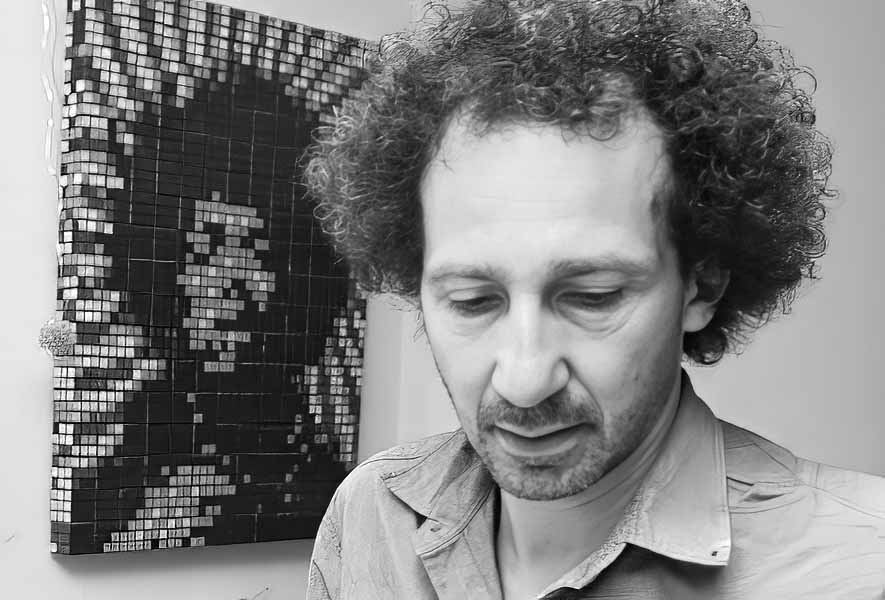
Long before “multimedia artist” became a job title anyone could claim, OOF — born Jaïs Elalouf — was already doing the thing itself: mixing sound, image, text, and other people’s attention into something that could only exist live, in a room, for the length of a show. He started DJing in 1992. Three decades later, the pseudonyms have multiplied — Zzouf, Lunivers, JAÏS, and now simply OOF — but the underlying instinct hasn’t changed: take fragments that don’t obviously belong together and make them cohere, just long enough for an audience to feel it.
A DVJ before the word existed
OOF’s core practice is Cinémix — an audiovisual performance format he built around mixing music, film footage, and dialogue live, without a script deciding where any of it lands. Les Inrocks described the result as a mix “perfectly settled,” where “images, sound and dialogs amaze instantly.” He has taken the show to more than 40 countries and performed it over 500 times, from festival stages like Montreux and Burning Man to the Grand Palais in Paris, where he and his band performed as part of the “Solutions COP21” event — an evening built around the same electro-documentary project that produced his 2016 EP as JAÏS, “Infinie Expansion.”
Across roughly 70 films — mash-ups, animated shorts, documentaries — he has treated the moving image as raw material rather than a finished product. Commissions have come from institutions with almost nothing in common with each other: Le Forum des Images, the aviation group Safran, the Maison Rouge museum, the National Film Board of Canada (a large-scale projection mapped onto a 50-meter church using Norman McLaren’s footage), and in 2019, France’s National Audiovisual Institute (INA), for a project on the origins of electronic music made in duo with J.B. Dunckel of AIR. As an associate artist at Le Centquatre in Paris, he also produced the “Nuits Ouf,” large-format night events, and conceived “Dance Conscious,” a video project aimed squarely at the machinery of consumer capitalism — industrial food waste, fossil fuel dependency, the quiet guilt of getting on a plane.
-
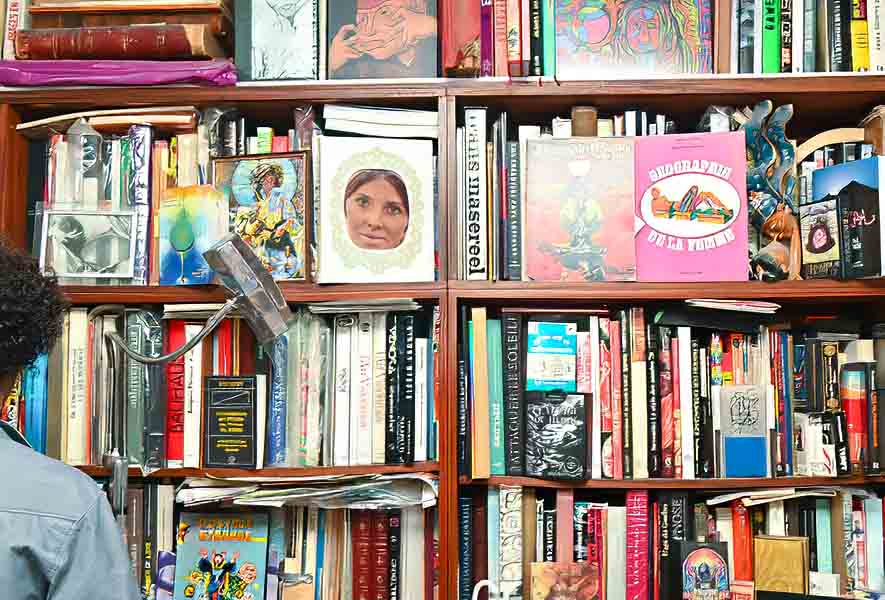
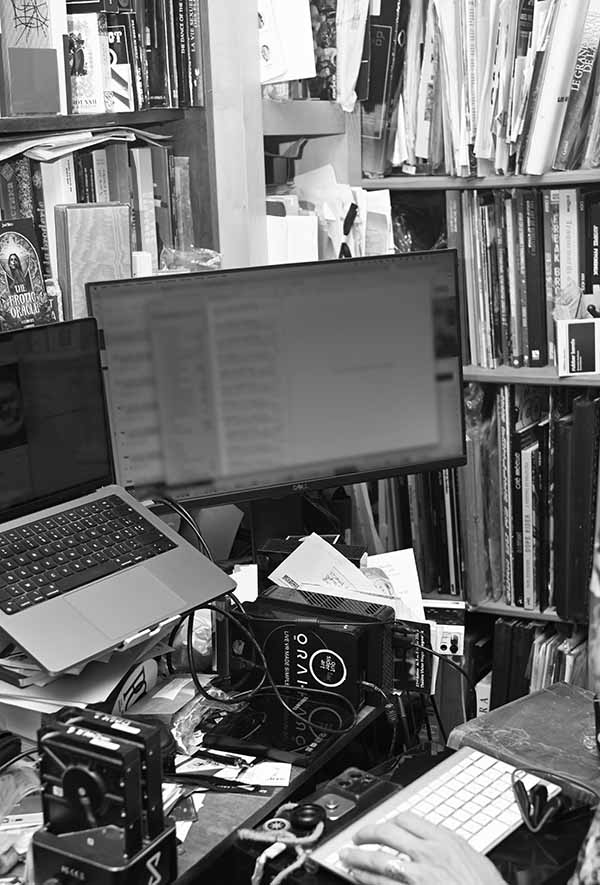
- His workroom.
-
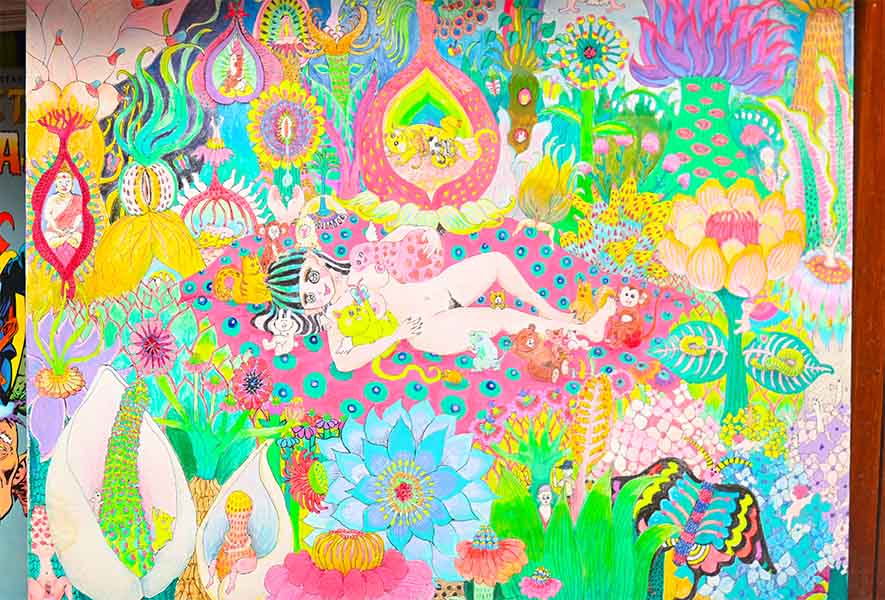
- By Noriko Miyake
A Tokyo and Kyoto chapter
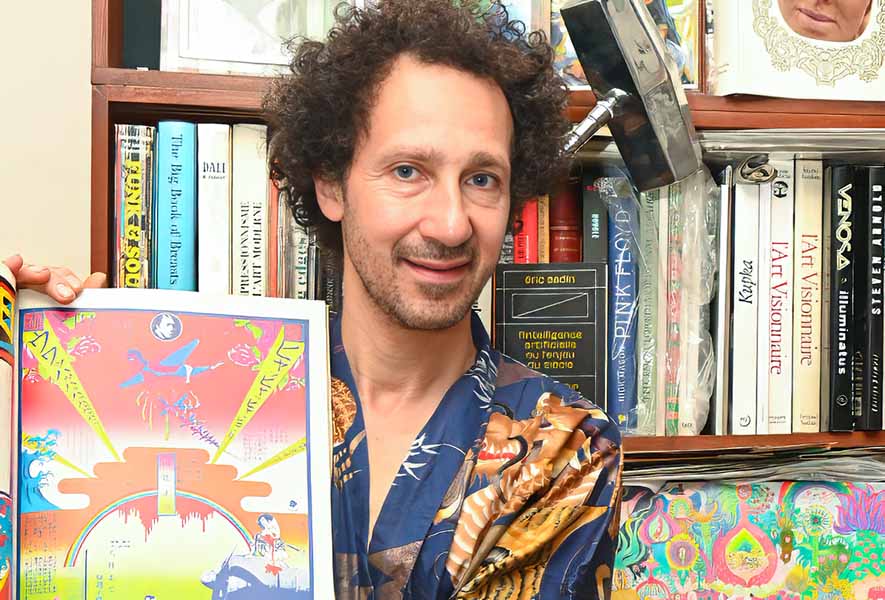
OOF’s connection to Japanese art is not a recent interest. In his twenties, he spent time working as a DJ in Tokyo and Kyoto — a period that, by his own account, gave him a lasting familiarity with Japanese artists. It shows up on his own shelves: among the psychedelic and outsider-art volumes he keeps close at hand is “100 Posters of Tadanori Yokoo,” a collection dedicated to the celebrated Japanese graphic artist, whose hallucinatory, boundary-crossing posters helped define Japanese psychedelic and pop art from the 1960s onward. It reads, in hindsight, like an obvious point of kinship — Yokoo built a visual language out of colliding references in more or less the same way OOF builds a set. The connection continued professionally: in 2004, when the Cinémix album was released in Japan, OOF returned for a dedicated Japan tour.
A collector who built an archive of the overlooked
Parallel to his music and video work, OOF has spent decades assembling one of the more significant private collections of psychedelic art — more than 8,000 pieces. It is not a passive collection. He has curated roughly 60 exhibitions drawing from it, at venues including the Biennale de Lyon, La Grande Halle de la Villette, New York’s Outsider Art Fair, and the LSD75 festival in Basel. In 2017 he launched Psychedelic.fr to give the movement a dedicated home online. His work in this space also lives on lucydelic.com, alongside shop.lucydelic.com and psychedelick.com. He is now working to build the Psychedelic Art Center, a future permanent home that would house the collection inside immersive spaces of his own design — the Cinémix instinct applied to a museum rather than a stage.
He also founded Ping Pong, a music PR agency, in 1998 — a business that has represented Ninja Tune, among others, for some fifteen years. It sits a little oddly next to the rest of his work until you notice the pattern: whether the medium is a nightclub set, a gallery wall, or a press campaign, OOF’s role keeps landing in the same place — the person who makes sure something gets seen, heard, or understood, and usually by connecting things that arrived separately.
A discography built on aliases
His recorded work spans roughly fifteen mixtapes under the Acid Test series, the album Cinémix (Universal), and a string of alter egos: Zzouf, a breakbeat project released on Tru Thoughts in 2004; Lunivers, whose 2013 single “Happy Route” became a Radio Nova playlist fixture; and his most recent name, simply OOF, aimed in a more musical direction than his earlier audiovisual work. Télérama has called him “certainly the finest specialist in psychedelia in France.”
Be the Change
His most ambitious current project, “Be the Change,” is a transmedia film built around a single question put to roughly 80 people around the world: what is, in your view, the solution to changing the world? It is, in miniature, the same working method that runs through everything else he makes — gather what other people are willing to give, and build the container that lets it be seen.
Why this matters for Human Light
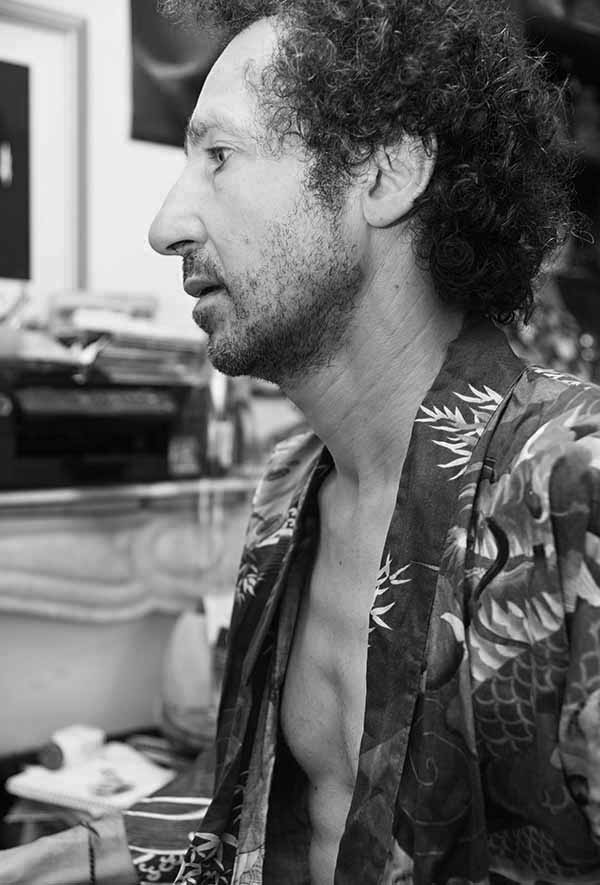
Human Light exists to record the presence of people who are living and working right now, before that presence gets smoothed into something generic. OOF’s work is, almost literally, about resisting that smoothing — collecting the art movements, footage, and voices that official culture tends to file away as marginal, and insisting they still have something to say. A man who has spent thirty years mixing other people’s fragments into something legible is, in his own way, already doing what this archive is trying to do.
photo: Mariko.A/ StudioTales
- Artist G: From the Neuroscience of Bias to the Architecture o...
- Karin Noda — In the Cloth, There Are People



 English
  日本語
日本語  Français